Sunday, November 10, 2013

Crocodiles and Fireflies


We're back in the trailer on the beach. One end has sunk even further into the sand so it's a little like being on a boat. We have to be careful how we place our glasses on the table. One day, Big Dog's glass slid right off the counter onto the floor, spilling his salty dog (isn't that what you call vodka and grapefruit juice?) Still, it's great to be lazy and nearly naked every day.

The crocs are bigger than ever and this year, I am seeing fireflies at night. And the beaches are still beautifully deserted.


Labels:

Saturday, December 15, 2012

Rincon de Québéc


A week ago, we moved from The Beach to The Town and into Don Beto's place. Don Beto runs a "bungalow" complex and it is filled with snowbirds from Quebec. We knew it from the fleur-de-lis banner waving from a second floor window. Canadians love their Maple Leaf flag and proudly fly it wherever they are staying, but the Québécois invariably favor their Province's fleur-de-lis. Maybe it's a welcome mat for other Francophone visitors. Or maybe it's a warning to Anglophones.

We didn't care. The price was right and we just needed a place for our last week in Mexico.

For me, it became a chance to bludgeon these poor Canadians with my terrible high school French. For the Canadians, we provided hours of entertainment (and head-scratching.) And it turned into something of an adventure for us all.

Labels: ,

Saturday, December 01, 2012

Doin' the Crocodile Rock


Okay, so it's buggy. My legs are pockmarked from weeks of mosquito bites. (No, I don't like pesticides and cannot stand putting them on my skin. And my citronella oil does not seem to be very effective.) Am I a weirdo for thinking that this is a small price to pay for fireflies at night?

In the Big Town -- as we've been calling our former home base (a small but growing fishing village/winter hangout for norteamericanos) -- they spray the canals and swampy areas to eliminate mozzies, but here, the mangrove swamp is a protected habitat for crocs and herons and bright red tree crabs.

These crocs look like something out of Jurassic Park.

Hello daaaaahling...
 Sometimes they break through the chainlink fence and come out onto the beach.


Never underestimate the speed at which a croc can move!

Pet owners, beware!
And when they are feeling particularly aggressive, they make the most amazing sound.

"I thought there was a weedwacker being used somewhere!" I marveled.
"You are so removed from nature," Big Dog laughed, reminding me of the Rattlesnake Incident.
"What do you expect? I've only lived in cities until a few years ago!"

Well, for all you other City Folk, let me present our Croc Video. Shot by Big Dog and quickly slapped together by moi. Be sure you have the volume turned up.


Labels: ,

Tuesday, November 13, 2012

Dulce


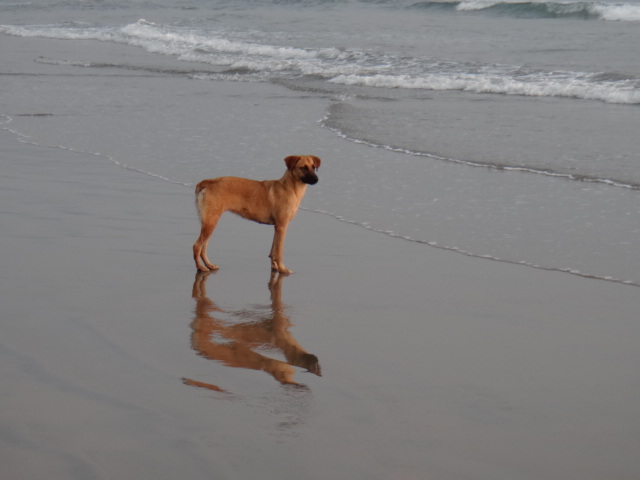
She was very attractive. Long and slender, with big eyes ringed in kohl like some Egyptian beauty but not at all aloof. No, she was frisky and playful. And heartbreakingly affectionate. She knew how to win over hearts.

"Shall I call you Cleo?" I laughed as she ran after some sand crabs.
"Or do you like Nefertiti better?"

The Tattooed One wasn't answering. Just splashing in the waves, running up ahead to chase a booby or two, digging in the sand to expose a hidden crab.

"I know you're thirsty," I kept rattling. "But we'll get to that sweet, sweet water soon. Aguadulce...aguadulce...."

She walked with us all the way up the beach to the north end where there a spring poured fresh water into the bay and we all refreshed ourselves in the cool water. By then, I was calling the caramel-colored girl Dulce, for her personality was as sweet.

"Are you coming with us, Dulce?"
We turned around to walk the 4km back home and Dulce didn't hesitate for a moment. Sometimes ahead of us, sometimes behind, but never too far away. When Big Dog stopped to take a photo, Dulce would look up, walk over to me and lean against my leg. Even Big Dog was impressed.

"Not only is she clean and good-looking, she's smart and so well-mannered! Wish our ranch dogs were more like her!" and we talked about how we would NOT adopt her. We had to. We had to give each other reasons why that was a Bad Idea.

Back at the trailer, I got a tub of water for her. When she whimpered, Big Dog let her into the trailer! (That was a surprised even to me!) But Dulce didn't start pouncing on the sofas, or chewing on stuff. It was as if she already knew what kind of behavior would allow her to stay with us and what wouldn't. She found herself a cool spot on the tiled floor and lay down until it was time for us to go and try to find some food. ("Which taco stand shall we go to tonight?")

Dulce came with us to the taco stand, got a few tidbits, then came back home with us for more chow.

"Do you remember Teo? That gay boy who followed D.?"
"Yeah. I can't believe D took him to our island," said Big Dog. "I don't think D knew Teo was gay. He probably thought, oh, good, a houseboy."
Teo was a good kid. Girly and giggly but very sweet, he looked after D like a girlfriend even though D was Very Not Gay. Funny how we both remembered Teo after more than 30 years.

"Maybe Dulce's like that. Maybe she finds a new 'friend' each season to love in return for food and shelter," I wondered.

Dulce slept on our porch last night as I dreamt of taking her home with me. And when I woke, I was practicing how to say "where does one buy dogfood in this town" in Spanish.

But by then, Dulce was gone. Gone, with a tiny little piece of my heart.

You Heartbreaker!

Labels: , ,

Monday, November 05, 2012

Life's A Beach


The Restless Dogs have left North America, returning to the Central Pacific Coast of Mexico.

In years past, we were happy to stay in a little village on Bahia de Navidad, but it's changed a lot since we first stumbled upon it in 2004.

First, some of the main roads were paved. Then, the next year, that paving was torn up to put in sewer lines. One year, the jardin, the central square, was redone (for no apparent reason.) Then, two bright florescent-lit convenience stores (Kiosko AND OXXO) opened to become glaring beacons in the night, out-shining the tiny neon cross of their church. Boys traded traditional vaquero (cowboy) attire so common in Jalisco for the boring B-Boy look you see everywhere. Girls went all J-Lo. We started hearing more hip hop and reggaeton than ranchera blasting out from the big black trucks that circled the jardin at night.

"I used to know everyone in the village," sighed G., our Japanese friend. "Now, I don't know anyone. They're all from somewhere else."

This sort of thing changes the fabric of society. And not in a good way.

So this year, we are north about 20 kilometers. If our former Mexican village was tiny, this one is positively microscopic. One carniceria (which runs out of meat a lot, seemingly), one lavanderia, one ferreteria (that is always closed except on weekends) and one farmacia (which might also be the one clinica, with their one and only doctora.) There are no pescaderias at all. The fisherman's co-op has the monopoly on fresh seafood.

For anything else,you go to the closest abbarotte, local stores that had the "convenience store" concept long before 7-11.

Nighttime dining is always a challenge in rural Mexico unless you can make do with tacos, tacos and more tacos, but here, it becomes an even bigger challenge when there are only 2 taco stands and they seem to be open only between 7 and 9pm.

And we are in a rusty fifth-wheel trailer that's been parked on the beach for 20-odd years, fighting bugs and sweating through the long hot airless nights.

I love it.

There's the sound of the surf at night, stars all a-glitter. Coconut palms fringe a long, lonely, undeveloped beach. Land hasn't been all parceled up and privatized yet. There are so few people here that everyone greets everyone else.

We are sandwiched between the ocean and a mangrove swamp that's home to some of the biggest and best-fed crocodiles I have ever seen. And life's pretty bitchin' in this sweaty, buggy paradise.

Labels:

Tuesday, March 20, 2012

Where Have All The Cornfields Gone?


I wondered about that for a long time.

In all the years and miles of traveling throughout Mexico, we have never seen any giant fields of corn. For all the corn that gets consumed in this country, there have been very few cornfields. On our current trip around southern Mexico, we've seen mountainsides covered with corn (between Palenque and San Cristobal de Las Casas) but they were still only big enough to feed the locals. So where are the giant fields feeding the nation's appetite for corn?

Now we know. They are in North America.

After NAFTA, Mexico got flooded with cheaply grown, government subsidized GM corn from North America. It wiped out the local farmers, pushing many of them to emigrate (legally or illegally) into the US for jobs. Some states are resisting the wave of cheap GM corn, but fighting Big Ag is always difficult, so I suspect we have eaten our share of tortillas and tamales made with GM corn masa.

This is not democracy! This is capitalism and corporatism at its worst.

But the bad news didn't end there. Turns out Big Ag isn't doing this just to poor little Mexico. Big Ag's already done its work in the US and Canada. Seems that almost everything made in a factory has some GM ingredient or another. Look at the labels. If it doesn't specifically say the product is organic or GM-free, you're eating a GM item. Anything with corn -- cereal, corn oil, corn syrup, corn starch, even vinegar -- is using GM corn (the majority of it is Monsanto's RoundUp Ready genetically engineered corn.) Same with soy, rapeseed (canola oil) and sugar unless it uses pure cane sugar.

It's so disturbing. The manufacturers of GE seed are telling us how safe it is. Then why is it banned in so many countries in Europe? Why do so many countries have laws making labeling of items containing GM ingredients mandatory? (And why don't the US, Canada and Mexico have these laws?)

I've read scientific studies that point to genetically engineered foods being responsible for an increase in auto-immune disorders, liver and kidney damage, allergies, learning disorders, accelerated aging, birth defects... the list goes on.

There's a movement in California now to put the labeling issue on the November ballot. Big Ag is doing everything it can to prevent this. Because they know that most people do not want GE foods so if it gets on the ballot, it will surely be voted in. And once labeling is mandatory, consumers will stop buying the products containing GM ingredients, manufacturers will stop using them and the whole GM business (oh-so-lucrative now) will disappear. (Hurray for consumers!)

Don't believe me? Go and see for yourself.

Labels: ,

Saturday, March 10, 2012

Tulum-lum-lum


Tulum-lum-lum
Tulum-lum-lum
It's a magical Mayan laaaand
in far off Yucataaaan

You're stuck inside a set for "Hair"
-- the movie, not the stage, if you care
With bronzed and pretty Euro chicks
all dressed up in hippie chic
strolling the beaches, kicking up
confectioner's sugar saaaand

Tulum-lum-lum
Tulum-lum-lum
It's a magical Mayan laaaand
in far off Yucataaaan

Oh, no, you can't be an extra here
You've got that gut belying too much beer
Don't ask for a posada economico
-- there's too much green in ecologico
Dollares, massages, noisy generators
all going hand in haaand

Tulum-lum-lum
Tulum-lum-lum
It's a magical Mayan laaaand
in far off Yucataaaan

Ejido's sold out to the highest bidder
promising a future of wealth and glitter
Who cares about the trash on the shores
Tourism is cash, so bring on more
Cancun's got vegas, a bit of disneyland
But Tulum's a rockin' hippie chickie laaaaand


And so it was. When we arrived in Tulum after 4 days in comatose Bacalar, I couldn't shake the cynicism away. All the "eco-resort" signs and massage-yoga-meditation vibe and over-priced cabanas lining the beach (and blocking my view, dammit!) All the young Europeans who've spent way too much to look like "hippies." All the hustle and bustle of a town teetering on the verge of a new level of development. And all the trash marring the breathtaking beauty of the Carribean Coast.

But something happened in the last few days: we rented a little studio apartment (ridiculously cheap for Tulum, though it's still double what we're used to paying) on the outskirts of town for the rest of our stay in Mexico and now, what do you know, I'm a local. So, now, although I am still in this Tourist Town, it doesn't bother me anymore.

I'm starting to enjoy watching the young Europeans who are all so much cuter and fitter than most North Americans. We've been picking up young travelers hitchhiking to get to the beach or back into town. (The beach hotels come at a premium -- okay for vacationers, but... -- so traveler types stay in town.) I'm still disappointed that all the fishing villages have turned into resorts and there's very little good fresh fish around, but we're getting into the groove. The Tulum groove. Tu-lum-lum-lum-lum-lum.

Mexico, on the road, 

Labels: ,

Wednesday, February 29, 2012

Water Colors


Labels: , ,

Wednesday, February 22, 2012

Welcome to Zapatista Country

We are now in Zapatista Territory, or so the sign tells us (warns us?) The jungles of Lacandon were home base for the rebels during their guerrilla war with the Mexican government not too long ago, but their influence spread throughout Chiapas. Yet, traveling through the state, it's hard to believe all of that was happening less than ten years ago. Today, there are still plenty of military camps all around the state, all heavily armed, but the real reminders of those turbulent days are the Zapatista souvenirs like stuffed dolls of Subcommandante Marcos and T-shirts printed with his visage and raised middle finger. Revolution reduced to merchandising. How 21st century!

"So this is where the 'hair skirt' ladies come from!" I said to Big Dog as we entered the village of Chamula, a few kilometers out of San Cristobal de Las Casas.
We had seen them all over SCLC (San Cristobal), selling macrame wrist bands, shawls and embroidered blouses. Women and girls in skirts made of furry black material, puffy-sleeved satin blouses and hair in braids.
"And the men are in hair vests!"
In the past, the vests and skirts were made of goat skin. Today. they are made of that horrible synthetic material you might get to make a bear suit.

It was Mardi Gras and the culmination of a week of celebrations in this town. People were everywhere. (You could tell the out-of-towners by their costumes.) But unlike festivals in Japan, or even other parts of Mexico, this one was an exclusive one. Foreigners were merely tolerated, and then not at all if they broke any rules. Like taking photos. (Once again, this rule only applies to foreigners. In guidebooks, they tell us that the locals "believe a photograph captures their soul" but watching all the colorfully costumed locals happily taking snapshots of each other with cellphones, you have wonder if only foreigners are capable of capturing souls with photographs.)

"What are they doing?"
We had gathered where there was a small mob. Men in hair vests were on either side of a double rope.
"Are they going to play tug of war?"
As we got closer, we saw that there was a bull in the middle. He looked scared and I felt bad for the poor animal. I wasn't sure I wanted to stay and see what happened to it.

Suddenly there was shouting and men waving sticks coming towards us. Uh-oh, they're going to set the bull free. I jumped back to the side of the street. But now, the angry men were coming after a Caucasian couple.
"I didn't do anything!" the man shouted, but the angry mob kept advancing.
"Fuck you!" one of them said to the man (in English.)
"You fuck off!" the man shouted back.
The mob grew, and grew more menacing. Wisely, the woman pulled her guy away and they walked off.

"He wasn't taking any photos," said Big Dog. "It was that group of gringos next to him."
"They're getting drunk and belligerent. I don't like this vibe."
"Let's get out of here."
"Yeah, before something really nasty happens."

What a difference from Japanese festivals which are just as colorful, strange, exotic and wonderful as any here. The Japanese also get mightily drunk during their festivals, but there is no aggression, no exclusion. They LOVE having outsiders experience what they feel is a special part of their culture. They WANT you to join in, get crazy and enjoy the festival. The gods would have it no other way. The sake flows easily and is offered to all participants, Japanese and non-Japanese.

I attribute the difference to a lack of confidence and the fact that these people were subjugated by outsiders for so long. Big Dog thinks it has to do with control.
"In a world where so much feels out of control, they guard what little they CAN control. Like having people take photos. Or enter their churches. Or have a good time."
It sounds a little stingy. Especially during a festival.

The indigenous peoples have been downtrodden everywhere, but until now, we have not had this unwelcoming vibe anywhere else. ("And don't they know the rest of the world was on their side during the Zapatista struggle?" They don't. At least not these villagers.) Maybe it's the sheer number of visitors to this part of Mexico that scares the locals, makes them less spiritually generous.

Or maybe it's just the itchy material of their skirts and vests.

Labels: , ,

Friday, February 17, 2012

Mayan Ruins and Lessons

Palenque was our fifth archeological site on this trip.


Our first one was small but jungly Ek Balam, with its superbly restored carvings on the main pyramid, followed by Chichen Itza the next day.

Chichen Itza is so well-known, we all feel like out of all the ruins we have to see it, but it is by no means the best archeological site. The craftsmanship here is not as good as other sites and so much of the site is roped off. The biggest bummer, though, are the tour buses filled with yahoos from Cancun's Zona Hoteleria. The ball court is supposed to have dynamite acoustics but all you can hear is "and then, she was, like, no way..." "so, I was, like, OMG!" Do people from other countries yak on about completely mundane matters, too? Perhaps they do and I am just lucky enough not to understand them.
The roots of tic-tac-toe?

Kinich Kakmo was a pyramid in the town of Izamal. From the street, you see a long flight of giant steps. (All of the ancient Mayan structures have giant steps. Were the ancient Mayans much bigger than present day Mayans?) After struggling up this flight, you come to a level spot and there in front of you is...another giant flight of steps to the REAL top of the pyramid. It was fun to watch the expressions of the people who had huffed and puffed their way to the top of the first steps only to find another set in front of them.

Unlike the others, the craftsmanship of the structures at Uxmal, further south, was astonishingly advanced. Stones were cut perfectly, eliminating the need for much mortar. Because it's not as crowded, nor does it have the yahoo population, there's more of a sense of mystery. You feel it particularly in the southern end -- it was probably a place of magic during its days -- with the House of the Mother of the Dwarf of Uxmal, as well as the phallic carvings.


Iggy stands guard

And now, Palenque, set in the lush jungles of Chiapas. It is huge. Lots of structures, some identifiable bas reliefs (many other sites have carvings too, but often times, they are so worn, you could not possibly imagine what they were supposed to depict) and even a cascading waterfall!
Palenque's "Queen's Bath." Now, who wouldn't want a bath like this?!

What is most fascinating to me is how you can see the rise and fall of a civilization through these ruins. Uxmal, which I thought had the highest quality craftsmanship, was built during the mid-point of the Mayan Civilization. I still don't know how they lost the know-how, but latter cities don't compare. We all think of progress as a given, to a certain extent. We think our age is better than that of 100 years ago, or 1000 years ago. We look at all the glorious achievements of mankind and think we'll continue to move forward, forever. Yet seeing the remains of cities hundreds of years apart, I realized that that is not always the case. Society deteriorates. Civilizations crumble.

The decline of the Mayans seems to have come from several factors. Their slash-and-burn farming techniques and clear cutting weakened the productivity of the land and changed weather patterns, bringing about hundreds of years of drought. The lack of adequate food was a cause of constant warfare, malnutrition and disease. If there were Mayans who warned of "global drying" there were probably many more in positions of great power who poo-poo'd them. Until it was too late, no matter how much blood was spilt for Chak Mool, their rain god.

This is the Mayan lesson we should be heeding. Be better custodians of our planet. If not, then we, too, are doomed.
Ukiyoe-esque relief of a Mayan King

Labels: ,

Tuesday, February 14, 2012

Mexico Is An Elephant

We've been on the road for a week now, blazing through the Yucatan, and once again I must say: Mexico is an elephant.

Remember that fable about the blind men and the elephant? Each person felt one part of the elephant and came to his own conclusion about what the animal was like. The one near its trunk concluded that "an elephant is like a snake," while the one near its leg concluded that "an elephant is like a tree." Or something like that.

Mexico is like that. Depending on which part you see, you get a completely different picture of Mexico.

Until now, I have only been on the Pacific Coast and central interior of Mexico but have had the audacity to write generalizations about Mexico based on that experience. I know better than to do that now.

The Yucatan area (the states of Quintana Roo, Yucatan and Campeche) has a completely different vibe. There are a thousand times more tourists here for sure. It's been a tourist draw for much, much longer and tourism is very well developed. It also seems the sheer number of visitors changes how the locals respond. They are not quite as over-the-top welcoming as in other areas, prices are jacked up more, and sometimes there is a two-tier price system: one price for Mexican nationals and one for foreigners.

The topography is also very different from what we have seen in other parts of Mexico. The Yucatan, especially the northern part, is FLAT with a sort of shrubby landscape that stays pretty much the same for the whole area. Driving the highways, you feel like you are in a maze, with a dense wall of green that you cannot see beyond.

We're blazing through towns and villages. We get to places, thinking we might hang out for a few days and leave within minutes. We keep comparing them to other places we have been and so far, they just haven't been up to par.

I had hopes for Merida -- friends had raved about the place -- but the colonial architecture is not as well-restored, there's a hodge-podge of newer, uglier buildings interspersed and worst of all, you cannot buy a beer after a certain hour on Sundays.

"I can see why people stay here, though," I said to Big Dog. "It's got art, music, cultural events. And while there are better towns for all of that in Mexico, they're all a bit colder this time of year. I'd give it a 7 on our 10 point scale."
"Huhn. You're still trying to find the positive in this place," BD snuffed. "It's still a 5 for me."

We're now in Campeche where the colonial architecture is stunningly restored, at least within the walled part of the city. The city makes an effort to keep it that way, with frequent fresh coats of paint. It's prettier but much sleepier than Merida, with less going on.

And it's still hard to find a shop selling beer!

So close to the garishness of Cancun's Hotel Zone, we find a quiet Mexican scene.


Quiet street of Izamal


Merida's cute dancers


Pretty pastel colored colonial buildings of Campeche

Labels: ,

Monday, February 06, 2012

Flying South...again

Our winter ranch work was finally done. I got to spend a morning picking chanterelles from the back woods and we even treated ourselves to some fresh crab from the Crab Guys in Avila. (You pick, they cook, you crack and clean and eat.) Of course, ranch work is never REALLY finished. We hadn't managed to get That Gopher nor the multitudes of them out there all over the place. I wasn't able to start a single crafts project. The greenhouse needs to be cleaned of all the plants that died during the few days of freak cold. And I will be missing the peak daffodil season, not to mention the breathtaking beauty of the plum, cherry, peach and nectarine blossoms.

But, here we are, flying south again, this time towards the Yucatan Peninsula.

Will it be all touristy? Will it be a noisy mess of springbreakers? Or will it be chilled-out? What are the locals like over there?

February has some interesting dates: 2-10-2012 (2102012!), 2-12-2012, 2-21-2012 (21022012!) I know. Getting too obsessed with numbers is a sure sign of craziness, but I am secretly hoping to get some answers from the Mayan Gods.

Will they? Will they let me in on their secrets? Will I find the key to the Mystery of Life?

Stay tuned.

Labels: ,

Thursday, December 01, 2011

Michoacan on a Prayer

Was it all that driving over rocks and rivers? Or was there a bit of subterfuge involved? Our exit out of the state of Guanajuato was delayed by a flat tire.

"There's a tire shop right up there," pointed out the window washer dude (who pointed out our flat tire after Big Dog laughingly brushed off the dude's offer to wash our car with an "It's a rent-a-car.")
"A little too convenient?" I wondered. "If I had a tire shop that wasn't doing much business, wouldn't it be great to find an out-of-state car parked all night just in front of my shop? And wouldn't it be great if in the morning it had a flat tire?"
"I don't think they're that devious," said Big Dog. He is always assuming the best in people. Some self-proclaimed misanthropist he is!

The tire shop being right there WAS convenient, though. 20 minutes later we were back on the road, on our way to "Don't Go There!" Michoacan.

"It's home of La Familia, one of the biggest drug cartels!"
"There are shoot outs all over Patzcuaro."
"They block the roads with buses and start shooting."
"The mountains are where they hang out."
"Driving the coast is equally dicey."
"It's as bad as Ciudad Juarez."

Mexicans and non-Mexicans alike had warned us from going through Michoacan. But it's our favorite state! The mountainous regions are gorgeous, the coast is desolate and serene, the colonial cities are massively impressive and the indigenous towns are too cool. All that talk of how dangerous it was kept us from going last time we were in Mexico, but this year we decided to risk it. It was the year of earthquakes and tsunamis and nuclear disasters, after all, not to mention our own truck collision, and strange medical moments. There were risks everywhere. You could stay at home to avoid it, and then slip in your bathtub and break your neck.

Still, I gripped my little Mitra amulet while on the road and maybe it was my guardian deity's powers that kept things peaceful the entire time we were in Morelia, Patzcuaro and on the coast. We only encountered one strange incident.

"Look, there's Che," said Big Dog as we approached our first toll booth out of Patzcuaro.
Huh? Che?
I looked ahead and not only was there a giant banner with Che Guevara's iconic face draped across from one booth to the other, there were big trucks, masked people and cars jammed up. Uh-oh. I gripped my amulet harder.

As we approached the toll booth, we realized that this was not a narco roadblock but protesting students who had taken over the toll booth. (Some students had been killed, as well as arrested and harassed, in a demonstration that took place a year or two ago and this was one of the actions commemorating the victims.) One of the bandana-masked boys handed me a tiny flyer explaining their mission and waved us through. It was almost a party.

"They didn't take our toll. I would have donated the fare for their cause," I mentioned as we passed through. I am such a sucker for causes. "But I wonder what they did with the regular toll collectors?"

We'll never find out, nor will we find out the fate of the protestors. As we drove towards the coast, a convoy of heavily armed military trucks were heading back towards Patzcuaro and the hi-jacked toll booth. Mitra in my hand, I said a silent prayer for peace. Peace for the protestors, peace for Patzcuaro, for Michoacan, for Mexico and the world.

Labels: ,

Saturday, November 26, 2011

Let's Get Lost

After days spent walking around San Miguel de Allende (and finding the Very Best Empanadas Ever at Empanadas di Loreto in front of the Oratorio) it was time to see what else was out there.

"We can drive to Atotonilco," I suggested, perusing my little guidebook. "We can take the Camino Viejo and the Route of Chapels..."

It looked pretty straightforward. Just head out of town on the main road in front of the main square and follow the signs...
Big Dog never trusts me or my judgement and made me ask the nice young man at the tourist office all the same.

"Is this where I make a right?" Big Dog asked me as we got out of town. "There's a sign pointing to Atotonilco..."
"I think that's the regular highway. The Old Road is the one up ahead, I'm sure," I answered. It was cobblestoned and certainly looked like The Old Road. The other road was just a regular asphalted highway.
"But didn't the guy at the tourist office tell us to make a right when we got out of town?"

I insisted we go straight. Big Dog did not share my confidence and so we asked several drivers and pedestrians along the way if this was the "camino viejo." "Yeah, sure," they all replied.

But the cobbled street soon became a rocky dirt road, and then a river crossing, and then no road at all. It was open countryside, with tracks in the pasture where wagons had been pulled. There were herds of cows and goats, a few horses, some cowboys on horseback, but no sign of anything suggesting a Ruta di Capillas, or Camino Viejo, or any chapel or church. Initially we followed the directions of the locals who pointed this way and that, until we finally realized: This was NOT El Camino Viejo for Atotonilco.

Road to Nowhere

Another Road to Nowhere

"I guess I should have asked them if it was EL Camino Viejo," I said sheepishly. "I was probably asking them if this was AN old road and they were all thinking, 'Well, duh, of course this is an old road!'"

We rattled all the way back to where Big Dog wanted to turn, way back when. Back over the no-road road, across the river (again), over the rocks, dirt and finally cobblestone street. The actual Camino Viejo which looked deceptively modern near San Miguel de Allende also quickly deteriorated into a dirt road, but it did take us by a collection of rather unimpressive chapels and tiny, sominiferous pueblos to Atotonilco, home of the Sanctuario.

A town along the Road to Somewhere...

...where we meet Rasta Dog.

"It's the Sistine Chapel of the Indigenos," enthused Mr. California. He had parked his big truck with a California license plate in front of us so we started chatting, finding out that he had exchanged his ranch in Atascadero, not too far from our ranch, for a place near this town.

Although the Sanctuario has interesting paintings on its walls, it really was no match for the real Sistine Chapel and in the end, Big Dog had to agree that the best part of the day was Getting Lost.

Not really the Sistine Chapel...

Was it all that driving along rocks? Or something more sinister? The next day, we discover our rental car has a flat tire.

Labels: , ,

Thursday, November 24, 2011

Shock and Awe

Most of Mexico's colonial past lies in the central highlands of the interior, from Oaxaca to Mexico City to Guadalajara.

Cobblestones, grand stone buildings, ironwork, pretty gardens and churches. Tons and tons of churches.

Big Dog is impressed with the speed at which the Spaniards built their impressive cities. Morelia was established less than 40 years after Christopher Columbus arrived in the New World. And now, here we were in San Miguel de Allende, in front of a church they had started building in 1511. That's less than 20 years after Columbus landed in Hispaniola!

I am impressed with the scale. The grandeur of many of the colonial cities has not diminished over the centuries. It's impossible to imagine just how these missionaries were able to build such huge churches, with soaring domes and elaborate detail -- so early on.

There are churches, cathedrals, temples, monasteries and convents all over San Miguel de Allende. Humonguous Baroque and Neo-classical structures rise from every street. There must be more Houses of God here per square mile than anywhere else, I thought.

Why would the Spaniards spend so much time and resources erecting so many churches? My theory is that the missionaries wanted to shock and awe the natives. Perhaps they felt challenged by the Aztec temples. "If these pyramids are what they're used to building for their gods, we better amp it up or we'll never get converts!" "Yeah, our God should have an even more impressive house!"

Interestingly, Jesus is not always "Top Dog" or, rather, Top God in these places. In many of the churches I've entered, it was the Virgin who had the "seat of honor." Just as curious is the realism of the statues -- compared to the monochromatic marble saints of many European churches, the figures in many Mexican places of worship are exceedingly realistic. Like, wax museum realistic. (And can be downright gory!)

Yes, it's a blurry shot but you sort of get my drift, right?

We weren't sure we'd like San Miguel de Allende because of its reputation as some sort of gringo retirement town. An Americanized Mexican town didn't sound too attractive to us. In reality, there weren't nearly as many North Americans as we had expected. Where had they all gone? ("First, it was swine flu, then the economy and now the narcos," mused the American owner of Pizza Pig, a pizza restaurant on the main highway from Dolores Hidalgo. "You'll see a lot of Texan women here in the summer, though. They leave their husbands behind to work in the Texas heat.") At any rate, we wound up loving the place. It was just as our new friend in Guadalajara, Maria Elena, told us: small, beautiful, arty, clean and with perfect temps.

Beautiful quiet streets...

...and lovely homes.

Plus, I found my all-time favorite church here: La Parroquia, a towering, airy, gay-wedding-cake of a cathedral. How can something so huge, feel so light? I loved it even more when I found out that the facade was constructed by an indigenous bricklayer and self-taught architect who had never been to Europe -- he based the design on postcards and lithographs, adding in his own touches. It's elaborate, pink and heartbreakingly pretty -- enough to make me want to...convert to Catholicism?!
My photos can't do it justice!


It even gets a fireworks show!

We thought they were rowdy tourists climbing up for a better view of the town. Turned out to be electricians adjusting the angle of the lights on the church. "Glad I didn't follow them up there," said Big Dog.

Chili-covered jicama popsicles!

Off to his gig...

Labels: , ,

Tuesday, November 22, 2011

Stairways to Heaven

Steps. More steps. Slopes. More slopes. Steep slopes. Steep steps. Houses on top of houses, a riot of color.

Guanajuato is a crazy cubist city of colored blocks upon blocks, built in a narrow valley. The city name means "the place of frogs" but frogs were soon replaced by the Spanish after silver was discovered in the surrounding mountains. There wasn't much space for a whole lot of growth, but grow they did -- upwards. No level ground? No problem. Just build vertically. Need to add more space? Keep building up -- or out, into space no one has taken yet.

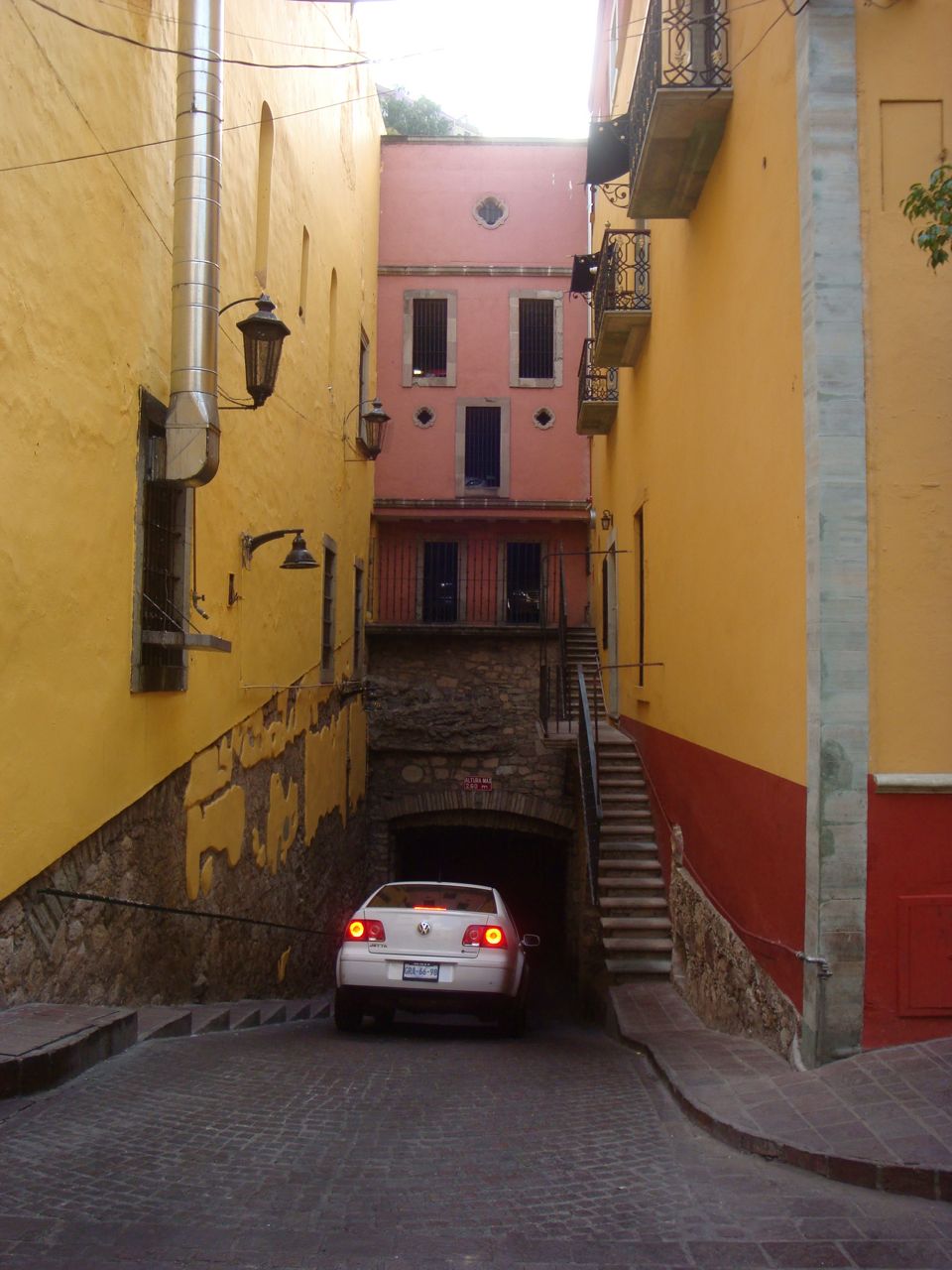
I had always wanted to visit Guanajuato. I had heard about the network of underground roads -- there wasn't enough space above ground for any major road system.

"If you take the wrong turn, you could really get lost. You could be stuck underground forever!" one elderly Canadian told us years ago.

Wow. I pictured some poor driver, driving endlessly underground until he ran out of gas. Cool. Way cooler than being stuck in a London roundabout.

It's also the "heart of Mexico" as I am reminded by slogans on buses and tourist information kiosks. The city prides itself on being at the geographic heart of Mexico, as well as the heart of its history and culture. There are majestic colonial buildings and churches, important sites in Mexico's struggle for independence from Spain, mines and mummies. Yes, mummies. Apparently, the climate of the area turns buried bodies into mummies instead of worm food and they are proudly displayed at the Mummy Museum, a must-see tourist spot. (So, of course, we avoided it!)

It is not a city for the timid. Streets and narrow alleyways, some only wide enough for walking single file, twist and turn seemingly haphazardly. It's a technicolor labyrinth, a maze. It must also be impossible to map because every map of the city looks different and none of them seem to actually match the actual terrain. Not even Google Maps can get it right. Are the maps even to scale? Who knows.

Maybe the best way to see Guanajuato is not to follow any maps at all, but just follow your nose. And work those thighs as you climb up up up and down down down, only to climb up again. But the locals must be used to all these stairs -- we watch in awe as little old abuelas trudge up seemingly endless flights of stairs to their casa, loaded down with groceries. They must have been doing it daily for close to a century, so how many stairs would that have been in a lifetime? For these grannies, maybe Heaven is a place without any stairs.

There are quite a few Mexican tourists here. It is where EL Pipila, a hero in Mexico's fight for independence, with only a stone slab on his back for armor, fought the Spanish and burned the granary where they were holed up. Luckily for the tourists, the city's one and only funicular leads straight to his giant statue high up on a hill, overlooking the city.

There are also a few European tourists and a handful of travelers from Japan, drawn to Guanajuato's culture, nightlife, art (Diego Rivera was born here) or youthful energy. The University of Guanajuato (you have to climb up stairs about four stories high to get to the main building) assures that there is a big population of young people and they seem far hipper here than elsewhere.

But you see very few North Americans. Not even the Canadians who populate the beach towns in the winter months. In Guanajuato, I didn't see a single Canadian flag. (As an aside, may I say that I find it one of the strangest habits of Canadians to fly their flag in foreign countries, and so casually.)

"All the walking you have to do to see the place probably keeps them away," says Big Dog.
"And the stairs," I add.

It's a shame, though, because it really is worth a visit. And I think it would be a fun place to live -- I kept eyeing pretty apartments with rooftop gardens. Sure, I'd be climbing a loooong (and winding) stairway to my haven, but imagine the workout I could get! I'd never need to pay for another gym as long as I lived here.

Up, up, up...

University of Guanajuato. Entrance is at the top of the stairs.

A pretty blue building in the distance caught my eye...

...and now I am finally, almost, there.

Stairs, stairs, everywhere.


And if the stairs collapsed...just put up a ladder.

Not very artistic papier mache renditions of Diego and Frida, at the Diego Rivera Museum.

Overview of a part of the city.

Narrow for the cars...

...and narrow for the pedestrians.


Unstable-looking additions, above and below.


The space above a street is good real estate in Guanajuato!


Best way to NOT walk these streets!

Minimal clearance! Not for the faint of heart. (Or a novice driver...)


Hard to tell if you're headed in the right direction, but maybe in this town, there is no WRONG direction.

Labels: , ,